.png)
Medicare Telehealth for PT, OT, and SLP: What's Actually Covered Through 2027

Updated: Aug 12
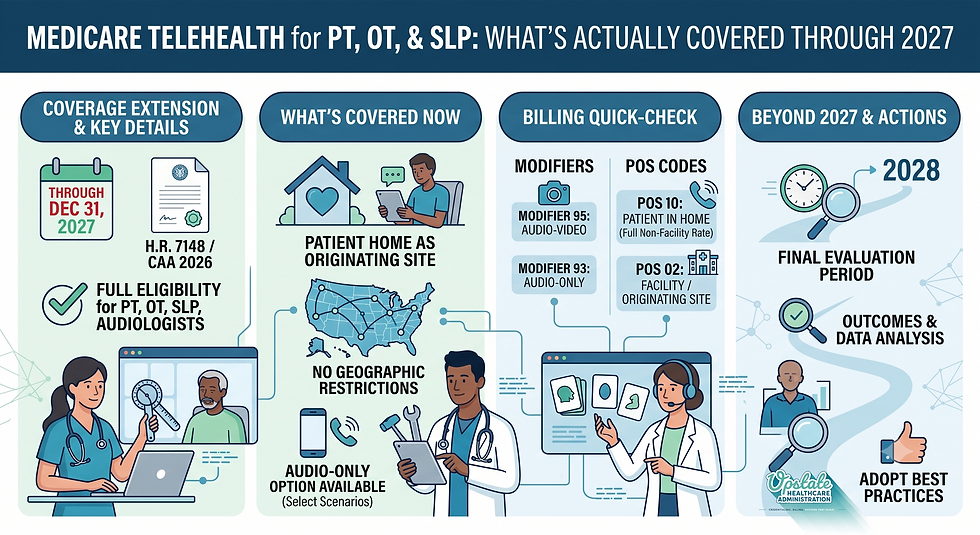
If you have been wondering whether Medicare still reimburses virtual therapy visits, the direct answer is yes. Physical therapists (PTs), occupational therapists (OTs), speech-language pathologists (SLPs), and audiologists remain fully eligible to bill Medicare for Telehealth services through December 31, 2027.
While political debates and temporary funding fights caused confusion early in the year, Congress officially resolved the status of therapy Telehealth. Here is what happened, what is covered today, how to bill correctly, and what your practice should prepare for over the next two years.
A Quick Timeline: How We Got Here
To understand why so many practices were left uncertain, a brief look at the timeline helps clarify where things stand:
The Expiration Window: Temporary Telehealth flexibilities enacted during the COVID-19 pandemic were set to expire on January 30, 2026.
Legislative Action: Congress passed H.R. 7148 (the Consolidated Appropriations Act, 2026), which was signed into law on February 3, 2026.
Retroactive Coverage: The law extended all key Medicare Telehealth flexibilities through December 31, 2027. Crucially, CMS confirmed that coverage applies retroactively for any claims during the brief lapse window, ensuring zero interruption in payment.
What Is Covered Now
Under the extended flexibilities, therapy providers maintain the broad authorities established in recent years:
Eligible Providers: PTs, OTs, SLPs, and audiologists continue to be recognized as distant-site Telehealth practitioners eligible to bill Medicare Part B.
Originating Sites: The patient's home remains an eligible originating site nationwide. Patients do not need to travel to a clinic or medical facility to receive virtual care.
No Geographic Restrictions: Telehealth services can be delivered to beneficiaries in urban, suburban, or rural areas alike.
Audio-Only Options: Audio-only Telehealth remains permitted for select clinical scenarios where two-way audio-video communication is unavailable or impracticable.
Billing Mechanics: Coding Telehealth Claims Correctly
While the extension guarantees coverage, receiving timely reimbursement depends on accurate claim submission. Telehealth visits for therapy are billed using standard CPT
codes alongside specific modifiers and place of service indicators.
1. Telehealth Modifiers
When submitting claims for Therapy Telehealth, you must append the appropriate modifier to indicate how the service was delivered:
Use Modifier 95 for synchronous, audio-video telecommunications.
Use Modifier 93 when audio-only delivery meets Medicare guidelines. For a deeper dive into choosing the right code for synchronous video versus audio-only visits,
review our detailed guide on: Modifier 95 vs 93
2. Place of Service (POS) Codes
Selecting the correct POS code determines whether your claim is reimbursed at the facility or non-facility rate:
Use POS 10 when the patient is located in their home during the Telehealth encounter.
Use POS 02 when the patient is located in a Telehealth facility or originating site outside the home. To ensure your practice receives the full non-facility reimbursement rate for home-based visits, read our guide on: POS 10 vs POS 02.
3. Fee Schedule Alignment
Telehealth visits are paid at the same rate as in-person therapy services under the Medicare Physician Fee Schedule. However, non-time-based codes like initial evaluations remain subject to broad policy updates. For more on overall rate adjustments, see our overview of the: 2026 fee schedule changes.
What to Watch for Beyond 2027
Healthcare leaders and federal lawmakers are calling this two-year extension a "final evaluation period." Between now and December 31, 2027, CMS and Congress will evaluate:
Outcomes Data: Demonstrating that virtual PT, OT, and SLP care produces comparable functional outcomes to in-person therapy.
Reimbursement Parity: Analyzing long-term costs and budget impacts across Medicare Part B.
Program Integrity: Ensuring robust documentation and fraud prevention protocols.
This extension provides stability through 2027, but practices should view Telehealth as a complementary service line rather than a permanent certainty. Building strong clinical workflows and maintaining precise documentation now will position your practice well, regardless of future legislative decisions.
If your practice needs help setting up compliant billing or auditing virtual care claims, check out our: Billing Oversight and Reimbursement for expert support.
Frequently Asked Questions
Is physical therapy covered under Medicare Telehealth in 2026?
Yes. Physical therapy, occupational therapy, and speech-language pathology are fully covered under Medicare telehealth throughout 2026 and through December 31, 2027.
How long is the Medicare Telehealth extension for PT, OT, and SLP?
Congress extended Medicare telehealth flexibilities for therapy providers through
December 31, 2027, under H.R. 7148 (Consolidated Appropriations Act, 2026).
What place of service code should I use for PT Telehealth visits?
When a patient receives Telehealth in their home, use POS 10. If the patient is at a clinical facility or non-home originating site, use POS 02.
Will Medicare Telehealth coverage for therapy become permanent?
Coverage is currently statutory through December 31, 2027. Congress will review clinical outcomes and financial data during this evaluation window before deciding whether to enact permanent legislation.
Are Medicare Advantage plans required to follow the same Telehealth rules?
Medicare Advantage (Part C) plans must cover at least the same core Telehealth benefits as Original Medicare, though individual plans may offer expanded coverage or specific billing rules. Always verify individual payer policies.
What is your platform actually costing you?


Comments