.png)
Private Practice vs Group Practice: What You Actually Take Home (Real Numbers)

If you’ve ever looked at a 60/40 split and thought, “That doesn’t seem that bad,” you’re not wrong.
On paper, it can feel fair. You show up, see clients, and someone else handles the rest.
But the real question is not the percentage.
It’s what you actually take home at the end of the day.
The Example Most People Don’t Run
Let’s use a simple, realistic number.
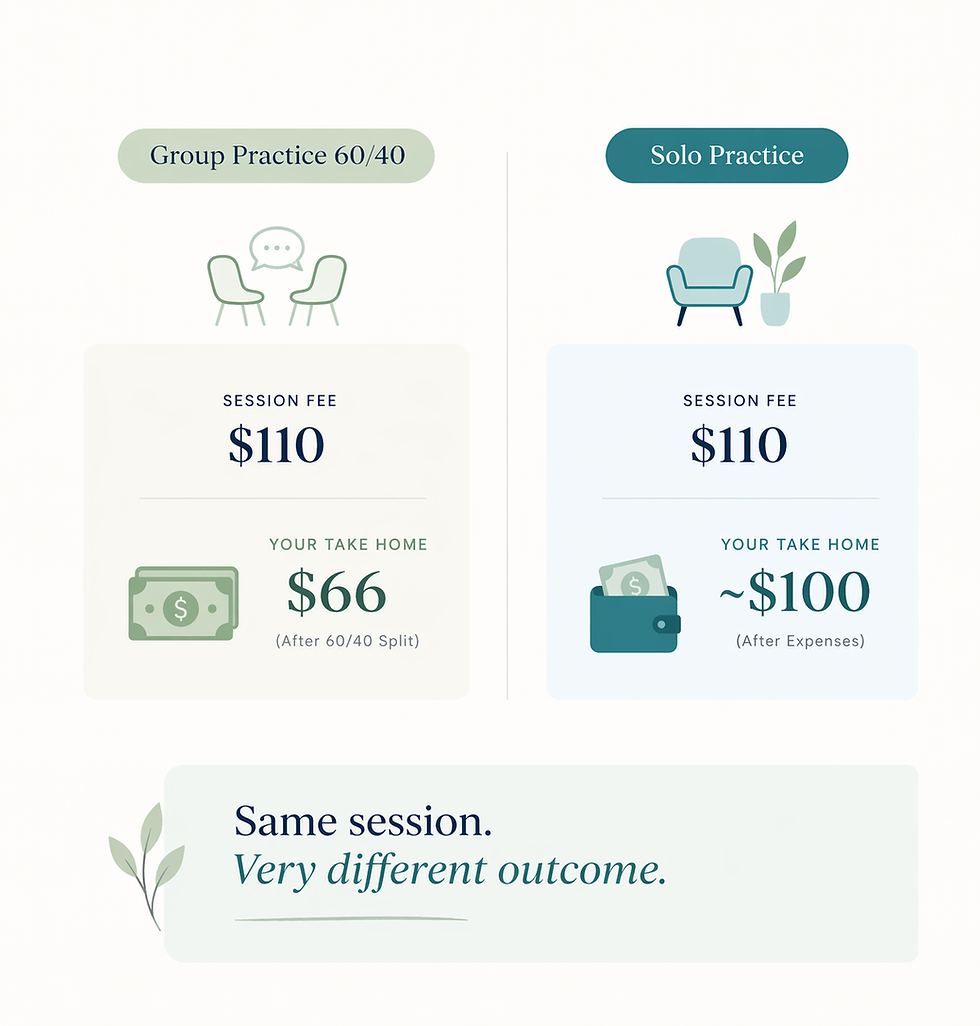
A session reimburses at $110.
At a 60/40 split, you keep 60 percent. That puts you at $66 per session.
That number matters more than the percentage.
Because now you have something real to compare.
What That Looks Like Over Time
At 25 clients per week, that’s $1,650 per week.
Over a year, that lands around $85,000 before taxes.
That’s the reality behind a “60/40” arrangement.
And again, it’s not bad. Especially if everything is being handled well on the backend.
But now let’s compare it to solo.
What Group Practices Are Supposed to Cover
That 40 percent is meant to cover real services.
Billing. Admin. Systems. Sometimes marketing. Sometimes referrals.
In a strong group practice, you should be walking into a full or nearly full caseload, with clean billing and minimal administrative burden.
That’s when a split makes sense.
You are trading a percentage for time, stability, and simplicity.
Where the Gap Starts to Show
The issue is not the split itself. It’s what you actually get for it.
Some group practices provide steady referrals and strong support.
Others provide a platform and basic billing, but expect you to fill your own schedule and manage parts of your workflow.
That’s where the math starts to shift.
Because if you are still responsible for bringing in clients or handling pieces of admin, you are not really offloading 40 percent of the work.
You are just giving up 40 percent of the income.
When Solo Starts to Win Financially
This is where most people underestimate the shift.
Let’s go back to that same $110 session.
If you are solo and collecting even $100 per session after expenses, you are already ahead of the $66 take home from a 60/40 split.
And most solo setups do not run anywhere near 40 percent overhead.
That does not mean solo is effortless.
It does mean the financial upside shows up sooner than most therapists expect.
Let’s Be Honest About Solo
Going out on your own does take work.
You are responsible for your systems. You need to understand your billing. You need a basic workflow that actually functions.
That part is real.
What gets overstated is how overwhelming it has to be.
With a clean system, most of this becomes very manageable.
You are not reinventing the wheel every week. You are following a repeatable process.
Verify benefits. See clients. Submit claims. Follow up.
When that structure is in place, the workload becomes predictable instead of chaotic.
The Real Tradeoff
This is what it actually comes down to.
Group practice offers simplicity upfront. You trade income for convenience and reduced responsibility.
Solo offers higher earning potential. You trade some responsibility for control and long term income.
Neither is wrong.
But they are very different paths.
When a 60/40 Split Is Worth It
A split can make sense if the practice is consistently filling your schedule, handling billing well, and removing most of the administrative burden.
In that case, you are paying for a real service.
It can also be a good stepping stone early in your career while you build experience and confidence.
When It Stops Making Sense
If you are bringing in your own clients, managing parts of your workflow, or questioning whether billing is being handled correctly, the value starts to drop.
At that point, the split is no longer buying you simplicity.
It is just reducing your take home.
The Bottom Line
A 60/40 split is not automatically good or bad.
It is only as fair as what you are getting in return.
The key is running the numbers and understanding your options.
Because for many therapists, solo becomes financially viable much earlier than they think.
If You Want to Run the Numbers Yourself
If you are trying to decide whether to stay in a group or go out on your own, you need to see your actual take home in both scenarios.
Need a clear billing workflow for your therapy practice?
The goal is not just independence.
It is building a practice that actually pays you well without burning you out.
Feeling like you are seeing more clients but taking home less?
If you are trying to decide whether to stay solo, expand your team, or restructure your practice, I offer exploratory chats for therapy and mental health practice owners who want real-world guidance rooted in operations, billing, and revenue strategy.
Book an Exploratory Chat and let’s talk through your practice goals, numbers, and next steps.


Comments