.png)
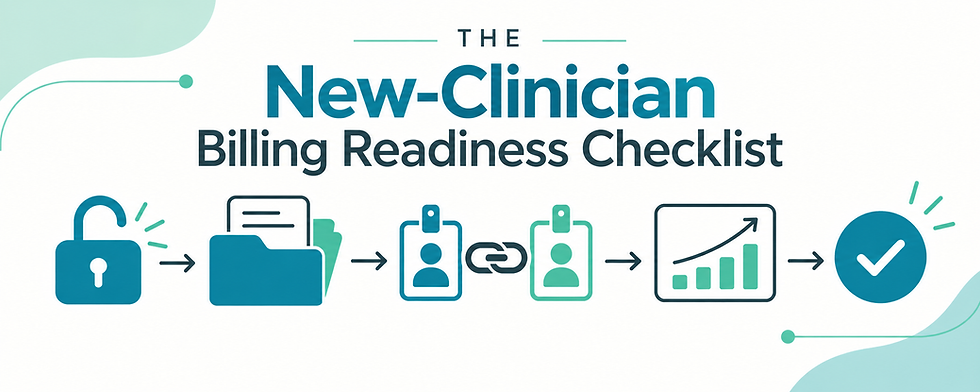
The New-Clinician Billing Readiness Checklist

Bringing a new provider onboard is an exciting milestone for any healthcare practice, but nothing halts momentum faster than billing bottlenecks. From delayed claims to outright denials, failing to complete every step of provider credentialing can freeze your revenue pipeline before it even starts.
To keep your operations running smoothly and ensure every service rendered is reimbursable,
follow this step-by-step readiness checklist before your new clinician sees their first patient.
1. Primary Credentialing & Licensing Setup
Before applying to insurance networks, all core credentials must be active, verified, and centralized.
State Licenses & DEA Registration: Verify that state medical licenses, DEA certificates, and state-specific controlled substance registrations are active with matching primary addresses.
Type 1 NPI Verification: Confirm the provider’s individual Type 1 NPI details, ensuring their primary taxonomy code accurately reflects their role in your practice.
CAQH ProView Profile Creation: Set up or update the clinician’s CAQH profile. Ensure 10 years of work history is documented without gaps, attest to the profile, and upload current CVs, malpractice face sheets, and licenses.
2. Payer Contracting & Group Linkage
Holding an active license is only half the battle; your practice must formally link the provider to your business entity.
Group Linkage Applications: Submit roster updates or re-credentialing applications to link the clinician's Type 1 NPI to your practice’s Type 2 NPI and Tax ID.
Medicare & Medicaid Roster Updates: Submit PECOS (Medicare) and state Medicaid enrollment updates (e.g., 855I / 855B forms) to assign benefits to your group.
Tracking Payer Effective Dates: Log application submission dates and monitor payer portals weekly. Commercial carriers often define effective dates differently, so track each approval status individually.
3. Financial Infrastructure & Portal Access
Even after a provider is approved, claims can still bounce if back-end electronic billing paths are not connected. Don't let unposted remittances pile up while EDI is being set up!
Clearinghouse Payer Enrollment: Update your electronic data interchange (EDI) enrollment through your clearinghouse so claims for the new provider route correctly.
EFT & ERA Setup: Set up Electronic Funds Transfer (EFT) and Electronic Remittance Advice (ERA/835) to ensure payments and EOBs flow directly into your practice bank account.
Payer Portal User Access: Grant the provider and billing staff access to payer portals (Availity, UHCprovider.com, etc.) for eligibility checks and prior authorizations.
4. The Final "Safe to Bill" Confirmation
Never assume a provider is ready to bill just because an application was submitted. Complete this final audit before releasing claims:
Verify Official Approval Letters: Do not bill until written confirmation with an explicit effective date is received from the payer.
EHR / Practice Management Alignment: Update your billing software to ensure the provider’s Type 1 NPI is set as Rendering Provider (Box 24J) and linked to your Group Type 2 NPI (Box 33).
Conduct a Test Claim Run: Run a test batch of 2 to 3 claims to confirm claim scrubbers do not flag missing provider links or invalid ID errors.
Frequently Asked Questions (FAQ)
1. How long does it take to complete the full onboarding checklist for a new provider?
The entire process generally takes 90 to 120 days. While core setup like CAQH and NPI updates can be completed within a week, payer committee reviews and clearinghouse enrollments account for the majority of the waiting period.
2. Can a new clinician see patients while clearinghouse enrollment is still pending?
Yes, but you should hold the claims in your practice management system until EDI and ERA enrollments are fully active. Submitting electronic claims before clearinghouse connections are complete will result in immediate payer rejections.
3. What is the most common reason for delays on this checklist?
Incomplete CAQH profiles and missing work history details are the top causes of delay. Payers will pause applications if there are unaccounted gaps of 30 days or more in a provider's CV or if attestation has expired. Build your Healthcare Administration Foundation the correct way!
How Much Are Credentialing Delays Costing Your Practice?
When a new provider's billing setup is delayed, your practice bears the cost of their salary and overhead without collecting the corresponding revenue.
The Financial Impact: Delays in completing billing readiness can cost your practice thousands of dollars a day in unbilled provider volume, and the losses compound the longer enrollment drags on.
The Cash Flow Gap: A 90 to 120-day delay in payer linkages can trap tens of thousands of dollars in held claims, with published industry analysis putting total lost revenue as high as $120,000 per provider over a 120-day delay.
Do not let onboarding administrative hurdles stall your new provider's productivity or disrupt your cash flow.

Take Control of Your Time-to-Revenue Today
Our credentialing specialists streamline provider onboarding, handle end-to-end clearinghouse enrollments, and track every payer effective date to get your clinicians billing safely and quickly.
Or if you want actual strategic guidance - not a template, but someone who can look at your specific payer mix, specialty, and practice structure and give you a real plan - you can book a strategy session through Upstate Healthcare Administration.


Comments