.png)
Why Credentialing Takes 90+ Days (and How to Not Lose Thousands While You Wait)

Updated: Jun 8
Nobody tells you this when you start your practice.
You spend weeks preparing to go in-network. You research the payers you want to work with. You pull together your licenses, your malpractice coverage, your NPI information. You submit the applications and feel, for a moment, like you have checked a major item off the list.
Then you wait.
And keep waiting.
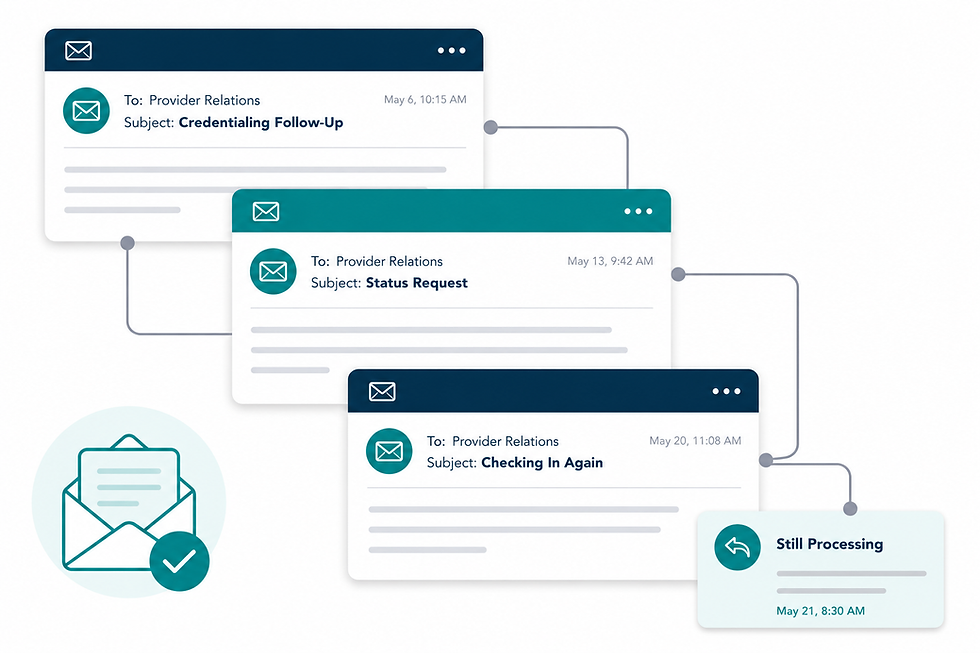
And at some point, usually around week eight, you start to wonder if something went wrong.
What Is Actually Happening During Those 90 Days
Credentialing is not one event. It is a sequence of verifications, each of which has to complete before the next one can begin.
When a payer receives your application, they do not simply approve it and add you to the network. They confirm your identity and credentials through primary source verification.
That means contacting your state licensing board directly, reaching your malpractice carrier, and checking the National Practitioner Data Bank for any sanctions or adverse actions. They also pull your CAQH profile to verify attestations and documentation.
Once primary source verification is done, your application moves to a credentialing committee. Many payers convene these committees monthly, not continuously. If your application completes verification the day after the committee meets, you wait another four weeks for the next session.
After committee approval, your contract gets generated, reviewed by their legal department, and sent to you for signature. Then it goes back, gets countersigned, and your effective date is set. That date is rarely immediate.
That chain, start to finish, is why 90 days is normal and 120 days is not unusual. It is not the system being unreasonable. It is just the system being the system.
Why Delays Happen Even When You Did Everything Right
Here is the part that surprises most providers: the majority of credentialing delays are not caused by the payer moving slowly. They are caused by information problems.
The most common culprits:
Your CAQH profile has something outdated. A malpractice certificate that expired three months ago. A license that was re-uploaded but the attestation was never re-confirmed. An old address that does not match your current practice information. Payers rely on CAQH heavily, and when what they pull does not match what you submitted, your application gets flagged and put aside until the discrepancy is resolved. You may not hear anything. You simply stop progressing.
Your application was missing something small. Different payers require different attachments. Some want a copy of your state license. Some require a W9. Some want proof of liability coverage showing specific coverage limits. Missing a single required document does not necessarily generate an automatic rejection. It often just quietly pauses your application until someone follows up.
Nobody followed up. Provider enrollment teams at large payers are handling hundreds of applications simultaneously. If there is an issue with yours, they may send one email or make one phone call and then move on. If you do not catch that and respond, your file can sit unresolved for weeks.
This is the visibility problem at the center of most credentialing delays, and we will come back to it.
The Hidden Cost You Are Probably Not Calculating
When you are in the middle of waiting, it is easy to think of the delay as an inconvenience. The number that actually matters is what you are not earning.
Consider a solo therapist who sees 22 clients per week at an average rate of $140 per session. Her monthly collections run close to $12,000 when she is fully operational.
If she credentials with a single major commercial payer and the process takes 120 days instead of the 60 she planned for, that is two extra months of either not seeing those clients at all, seeing them out of pocket at a reduced rate, or absorbing a significant income shortfall while she waits.
At her volume, that gap represents roughly $24,000 in delayed revenue just from one payer.
Not lost permanently, but deferred in a way that can seriously strain a new practice.
A PMHNP running a higher billing rate sees those numbers grow even faster. A 90-day credentialing delay on a Medicaid managed care plan with a panel of 30 clients can represent 15 to 20 thousand dollars in delayed or unrealized revenue in the first year alone.
These are not edge cases. They are routine outcomes for providers who start the process without enough lead time or without tracking it closely.

The Visibility Problem
The reason most credentialing delays go undetected for so long is simple. Providers do not know what normal looks like or where they stand relative to it.
If you submitted an application six weeks ago and have not heard anything, is that fine? Is that slow? Did something get lost? You genuinely cannot tell. And so you either assume everything is fine and keep waiting, or you call the payer's provider line, wait on hold for forty minutes, and get told someone will look into it.
Most providers do not have a systematic way to know:
What the expected timeline is for each specific payer they submitted to. What stage each application is in. What outstanding items could be causing a hold-up. When it is time to follow up and with whom.
Without that information, credentialing becomes a passive activity. You submit and then hope. If something is wrong, you find out only when it becomes impossible to ignore, which usually means many weeks have already passed.
What Changes When You Track It Properly
Credentialing is not faster when you track it well. Payer timelines are what they are.
What changes is your ability to intervene when something goes wrong.
When you know that a specific payer typically processes applications in 60 to 75 days and yours is at day 80 with no status update, you know to make a call. When you know that CAQH re-attestation is due in two weeks and your malpractice certificate expires in six weeks, you handle both before they become problems.
Proactive tracking does not make the bureaucracy move faster, but it does prevent the compounding delays that happen when small issues go unnoticed for months.
The providers who move through credentialing most smoothly are not the ones who submitted perfect applications and got lucky. They are the ones who followed up at the right times, caught issues early, and kept their documents current throughout the process.
Building a System That Works for Your Practice
If you are in the middle of a credentialing process right now, or planning to start one, here are the most important things to have in place.
Audit your CAQH before submitting anything. Verify that your licenses are current, your malpractice documentation is uploaded and not expiring in the next 90 days, and your practice information is accurate. Do this before every new application cycle, not once and never again.
Build a timeline for each payer. Know when you submitted, what their typical processing window is, and when you should expect to hear something. Put a follow-up date on your calendar at the 45-day mark for most commercial payers, earlier for Medicare and Medicaid.
Keep a single source of truth. Whether that is a well-structured spreadsheet or a dedicated credentialing tracker, make sure every document, every date, and every status note is in one place. If you cannot answer in sixty seconds where each application stands, your system is not working.
If you are managing multiple payers or a growing panel, consider whether you want to handle this yourself. The time cost of tracking five or six simultaneous credentialing processes is significant, and the financial cost of a missed follow-up can be much higher.
We Can Help You Close the Gap
At Upstate Healthcare Admin, credentialing management is one of the core services we provide to solo providers and small practices. We track your applications, follow up with payers, flag issues before they cause delays, and keep your documentation current.
For practices that are just getting started, we help set up the right systems from day one.
For established providers who have been burned by delays before, we take the tracking off your plate entirely.
If you want to talk through what your credentialing situation looks like right now, reach out at upstatehealthcareadmin.com. We are happy to take a look and tell you honestly where you stand.


Comments