.png)
NYS Medicaid Rates for Mental Health Providers: What Your License Type Actually Gets Paid

Updated: Sep 20
One of the most common reasons therapists in New York avoid Medicaid is the assumption that the rates are not worth it. For most license types, the published fee schedule tells a different story.
How Much Does Medicaid Pay Therapists in New York?
Under the New York State Medicaid fee-for-service (FFS) fee schedules published on eMedNY, a 60-minute psychotherapy session (CPT 90837) pays $136.91 for LMHCs and LMFTs, $145.02 for LCSWs, and $153.07 for psychologists (the non-facility fee). A 45-minute session (CPT 90834) pays $93.58 to $104.59, and a 30-minute session (CPT 90832) pays $70.91 to $79.25, depending on license type.
These are fee-for-service amounts. Medicaid managed care plans pay network providers under their own contracts, so your contracted rate may differ from the FFS schedule. Full tables by license type are below.
Rates and policy information last verified September 2026. Sources are linked throughout and listed at the end of this article.
This post is written for masters-level and doctoral-level mental health clinicians in private practice in New York State - LCSWs, LMHCs, LMFTs, and psychologists (PhD/PsyD). The rates you receive from New York Medicaid are not the same across all of these licenses. They come from separate fee schedules, and the differences are meaningful. Here is exactly what each credential earns under the current eMedNY fee schedules, alongside illustrative commercial ranges for context.
PMHNPs can also enroll with New York Medicaid, but they are paid under the eMedNY Nurse Practitioner fee schedule, whose procedure code list is organized around evaluation and management (E/M) visits and does not include the stand-alone psychotherapy codes compared here. To avoid a misleading side-by-side comparison, PMHNPs are not included in the tables below. For psychiatric NP billing strategy, see this 2026 PMHNP revenue guide.
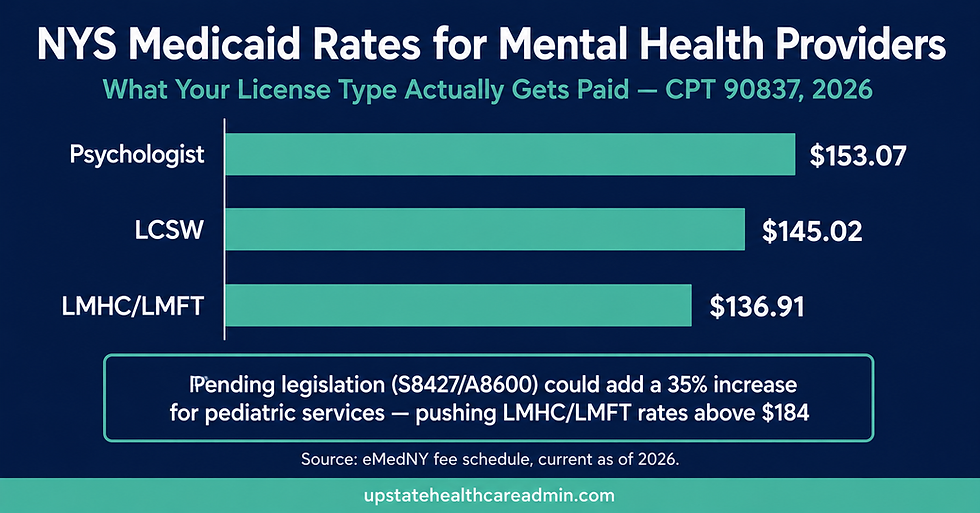
The Rate Comparison, by License Type
New York Medicaid uses separate fee schedules for different provider categories. The Medicaid numbers below are sourced directly from current eMedNY published documents: the Clinical Psychology fee schedule (effective January 1, 2026), the LMHC and LMFT fee schedule, and the LCSW fee schedule.
How to read these tables: The NYS Medicaid FFS column is the published state fee-for-service amount. The BCBS, UnitedHealthcare and Aetna columns are illustrative ranges for comparison only. They are not published fee schedules and are not verified against any specific contract. Actual commercial rates vary by plan, location, provider type, network and contract. Medicaid managed care plans may also pay amounts that differ from the FFS schedule.
CPT 90837 - Individual Psychotherapy, 60 minutes
Credential | NYS Medicaid FFS (published) | BCBS (NY), illustrative range | UnitedHealthcare (NY), illustrative range | Aetna (NY), illustrative range |
Psychologist (PhD/PsyD) | $153.07 | $130–$200 | $133–$160 | $151–$175 |
LCSW | $145.02 | $100–$165 | $110–$145 | $120–$155 |
LMHC / LMFT | $136.91 | $90–$145 | $95–$130 | $100–$140 |
Psychologist amounts are the non-facility fee. eMedNY lists a lower facility fee for psychologists when services are provided in a facility setting (for example, $57.05 for 90837). The LCSW and LMHC/LMFT schedules list no facility fee.
CPT 90834 - Individual Psychotherapy, 45 minutes
Credential | NYS Medicaid FFS (published) | BCBS (NY), illustrative range | UnitedHealthcare (NY), illustrative range | Aetna (NY), illustrative range |
Psychologist (PhD/PsyD) | $104.59 | $87–$130 | $98–$120 | $114–$135 |
LCSW | $99.08 | $75–$120 | $85–$110 | $95–$120 |
LMHC / LMFT | $93.58 | $70–$105 | $75–$100 | $80–$110 |
CPT 90832 - Individual Psychotherapy, 30 minutes
Credential | NYS Medicaid FFS (published) |
Psychologist (PhD/PsyD) | $79.25 |
LCSW | $75.08 |
LMHC / LMFT | $70.91 |
Commercial ranges are not shown for 90832 because this article has no NY-specific commercial range for it. For general commercial ranges across 90837, 90834 and 90832, see this 2026 insurance reimbursement breakdown by CPT code. Per the eMedNY policy manual, 90832 is typically 16 to 37 minutes, 90834 is 38 to 52 minutes, and 90837 is 53 minutes or more.
CPT 90791 - Psychiatric Diagnostic Evaluation
Credential | NYS Medicaid FFS |
Psychologist (PhD/PsyD) | $168.79 |
LCSW | $159.90 |
LMHC / LMFT | Not on LMHP schedule |
Additional LMHC/LMFT codes from the current eMedNY LMHP fee schedule:
Code | Service | NYS Medicaid FFS |
90785 | Interactive complexity add-on | $10.70 |
90839 | Crisis psychotherapy, first 60 min | $120.68 |
90846 | Family therapy without patient | $88.68 |
90847 | Family therapy with patient | $91.99 |
90853 | Group psychotherapy | $24.84 |
What This Actually Means by Credential
If you are a psychologist, New York Medicaid pays $153.07 for a 60-minute session (non-facility fee). That sits inside the illustrative BCBS and Aetna ranges above and near the top of the illustrative UnitedHealthcare range, so the financial case for enrolling is worth a serious look.
If you are an LCSW, Medicaid is competitive with commercial contracts. At $145.02 for a 60-minute session, the published rate is above the midpoint of each illustrative commercial range shown above, though individual contracts negotiated in higher-cost markets can exceed it.
If you are an LMHC or LMFT, the picture is stronger than most people assume. At $136.91 for a 60-minute session, the published Medicaid rate is above the top of the illustrative UnitedHealthcare range ($95–$130) and above the midpoint of the illustrative BCBS and Aetna ranges. Whether it beats your specific BCBS or Aetna contract depends on your market and what you negotiated, so compare it against your own contracted rates. With no patient balance to collect in most cases, the rate makes a credible case for enrollment.
For context on how your current commercial rates compare, this 2026 insurance reimbursement breakdown by CPT code is worth reviewing alongside these numbers. And if you are currently weighing whether to stay in-network at all, the in-network vs. out-of-network decision guide walks through how to think about that strategically.
Proposed Children's Behavioral Health Rate Increases (Not Yet Enacted)
Two bills in the New York legislature, Senate Bill S8427 and Assembly Bill A8600, propose higher Medicaid payments for outpatient behavioral health services for people under 21. These are proposals, not enacted law. As of September 21, 2026, both bills are still in committee (the last recorded action on each was January 7, 2026) and neither has passed either house. The Assembly bill's text lists an April 1, 2026 start, which has already passed, so no implementation date currently exists. The enacted 2026-27 state budget did not include the children's outpatient rate increase, according to Citizens' Committee for Children of New York.
As written, the bills would raise Medicaid payments for outpatient behavioral health clinic services for individuals under 21 provided under Articles 31 and 32 of the Mental Hygiene Law by at least 35%, add a 3.2% trend factor, and cost roughly $200 million in additional gross Medicaid spending. The bill text does not mention the individual practitioner fee schedules for LMHCs, LMFTs, LCSWs or psychologists shown above, so do not assume a 35% increase to those rates. If you are deciding whether to enroll, base the decision on the current published rates.
Why Medicaid Plans Have Reason to Add Providers Right Now
New York's behavioral health network adequacy standards took effect July 1, 2025 for Medicaid managed care plans, Child Health Plus and the Essential Plan, and they reach commercial plans on a rolling basis as policies are issued or renewed on or after that date (commercial plans fall under DFS Regulation 11 NYCRR 38). Under the standards, a plan must be able to offer a new patient an initial outpatient behavioral health appointment within 10 business days of the request, and must give a member a list of available in-network providers within three business days of a request, according to the NYS Department of Financial Services.
New York also has documented shortages of mental health providers, especially in rural areas. A 2025 State Comptroller analysis found the rural counties' mental health practitioner ratio (6.9 per 10,000 residents) is less than half the statewide ratio (16.1), and all 16 rural counties reviewed are federally designated mental health shortage areas.
Plans working to meet those standards have a reason to bring more clinicians into their networks. Panel availability and credentialing speed still vary by plan, county and license type, so ask each plan whether it is accepting your license type in your area before you apply.
For a realistic look at the full credentialing timeline, this payer-by-payer breakdown is worth reading before you start the process.
Who Can Enroll and Who Cannot
To be paid by a New York Medicaid managed care plan, you generally must also be enrolled in the state Medicaid program through eMedNY. The requirement comes from the federal 21st Century Cures Act, which eMedNY describes as applying to managed care network providers. The Department of Health's April 2022 Medicaid Update states that as of September 1, 2022, managed care plans deny services from non-enrolled providers who serve more than ten members in a 180-day period. Without eMedNY enrollment, managed care Medicaid claims can deny even if you hold a plan contract.
Fully licensed clinicians who can enroll independently: LCSWs, LMHCs, LMFTs, licensed psychologists, and PMHNPs. The eMedNY policy manual requires LCSWs, LMHCs and LMFTs to be licensed and registered with the NYS Education Department.
Who cannot enroll independently: LMSWs and limited permit holders, including limited permits in counseling and marriage and family therapy. Under the eMedNY policy manual, services by an LMSW or a limited-permit LCSW/LMSW can be billed under the supervising LCSW's NPI, and services by a limited-permit LMHC or LMFT can be billed under the supervising LMHC's or LMFT's NPI. A supervising LCSW can supervise up to six LMSWs. Clinicians in other pre-licensed categories should confirm the billing rules with eMedNY before assuming supervised billing applies. For group practice owners, this supervised billing structure is worth modeling before you decide, and this group vs. individual credentialing guide covers the enrollment side.
The setup sequence - NPI, eMedNY enrollment, CAQH synchronization - has a specific order that matters. This post on what comes first walks through it clearly. CAQH ProView data also has to be re-attested on a recurring schedule (commonly every 120 days), so this is ongoing maintenance, not a one-time task.
The Billing Simplicity Argument
Beyond the rate comparison, there is an operational case for adding Medicaid to your payer mix that applies across all credential types.
New York's Medicaid copay schedule lists specific services, such as Article 28 clinic visits, lab tests and prescriptions, and exempts members under 21, so there is usually no patient balance to collect for outpatient therapy with a private practitioner. Confirm each member's coverage and cost-sharing through eligibility verification before the visit. New York also enacted two patient billing laws in October 2024 that changed how providers can store credit cards and obtain payment consent from commercial and private-pay clients - adding compliance overhead that Medicaid billing largely sidesteps. For fee-for-service members, claims submitted through ePACES show status the same day, with no merchant processing fees and no patient bad debt. Claims for managed care members go to the plan and follow that plan's payment timeline.
If your current billing setup has more friction than it should, this guide to building a lower-stress billing system covers the foundations.
What the Numbers Look Like in Practice
These are gross billings at the published fee-for-service rate, before overhead. You still need referrals and a full schedule to reach them.
LMHC or LMFT, solo practice: At 25 sessions per week for 48 weeks at the current 90837 Medicaid rate, gross annual billings come to approximately $164,000. There are no patient balances to chase.
LCSW, solo practice: Same model at $145.02 produces approximately $174,000 annually.
Psychologist, solo practice: Same model at $153.07 produces approximately $184,000 annually.
Group practice with supervised clinicians: LMSWs or limited-permit LCSW/LMSW staff billed under a supervising LCSW at 30 sessions per week for about 45 working weeks at the $145.02 LCSW rate generates roughly $195,000 per clinician per year in gross billings, before overhead and supervision costs. For a realistic look at how solo and group models actually net out after overhead, this private practice vs. group practice income comparison is a useful reference.
Frequently Asked Questions About NY Medicaid Rates for Therapists
How much does Medicaid pay therapists in New York?
Under the eMedNY fee-for-service schedules, a 60-minute session (CPT 90837) pays $136.91 for LMHCs and LMFTs, $145.02 for LCSWs and $153.07 for psychologists. A 45-minute session (90834) pays $93.58 to $104.59 and a 30-minute session (90832) pays $70.91 to $79.25, depending on license. Managed care plans may pay different contracted rates.
How much does NY Medicaid pay for CPT 90837?
CPT 90837 covers psychotherapy sessions of 53 minutes or more. The published fee-for-service rate is $136.91 for LMHCs and LMFTs, $145.02 for LCSWs and $153.07 for psychologists (non-facility fee). Psychologists are paid a lower facility fee, $57.05 for 90837, when services are provided in a facility setting.
Does NY Medicaid cover LMHCs?
Yes. LMHCs who are licensed and registered with the NYS Education Department can enroll in NYS Medicaid fee-for-service and bill under the LMHC and LMFT fee schedule. LMHCs with a limited permit cannot enroll independently, but their services can be billed under the supervising LMHC's NPI.
Can LMFTs enroll with NY Medicaid?
Yes. Fully licensed LMFTs can enroll independently and are paid under the same fee schedule as LMHCs. LMFTs with a limited permit cannot enroll, but their services can be billed under the supervising LMFT's or LMHC's NPI.
How much does Medicaid pay LCSWs in New York?
The published fee-for-service rates for LCSWs are $145.02 for 90837, $99.08 for 90834, $75.08 for 90832 and $159.90 for a 90791 diagnostic evaluation. LMSWs cannot enroll independently, but their services can be billed under a supervising LCSW's NPI.
Is NY Medicaid fee-for-service reimbursement different from Medicaid managed care reimbursement?
It can be. The fee-for-service schedule is set by the state and published on eMedNY, while Medicaid managed care plans pay network providers under their own provider contracts, so your contracted rate may differ. You still need to be enrolled in eMedNY to be paid by a managed care plan, so ask each plan for its fee schedule for your license type before you sign.
The Short Version
New York Medicaid is a serious payer for every master's-level and doctoral-level mental health license type in private practice. LMHCs and LMFTs sit at $136.91 for a 60-minute session - above the illustrative UnitedHealthcare range and competitive with mid-tier BCBS contracts. LCSWs and psychologists earn even more. New York has documented provider shortages, especially in rural areas. Pending legislation could raise children's outpatient behavioral health rates, but it has not passed and does not clearly reach the practitioner fee schedules shown here.
If you have been putting off the eMedNY enrollment process, the useful next step is to run your own numbers and confirm which plans will accept your license type, because managed care claims depend on eMedNY enrollment.
Thinking about going independent? Upstate handles the credentialing, billing setup, and platform exit planning so you keep your caseload and your revenue. Run your numbers with the Hidden Spread Calculator or book a free 15-minute call to talk through your situation.
Not Sure Whether Medicaid Makes Sense for Your Payer Mix?
The eMedNY enrollment process has different forms and sequences depending on your license type, practice structure, and whether you are enrolling solo or as part of a group. Getting the setup right the first time helps prevent the claim denials and CAQH revalidation issues that can push timelines back.
If you are still deciding, a strategy session ($199) is the right starting point. It maps your license type, current contracts and county against the rates above so you can decide whether Medicaid belongs in your payer mix before you submit anything. This guide to the signs your payer mix needs a review is a useful warm-up.
If you have already decided to enroll, UHA can handle your Medicaid credentialing and enrollment, including the order of NPI, eMedNY, CAQH and plan applications, so the setup is done right the first time.
Sources: eMedNY Clinical Psychology fee schedule (effective January 1, 2026); eMedNY LMHC and LMFT fee schedule; eMedNY LCSW fee schedule; eMedNY LCSW, LMHC and LMFT policy manual (July 2025); eMedNY Nurse Practitioner procedure codes (April 2026); NYS DOH Medicaid Update, April 2022; NYS DFS behavioral health network adequacy announcement, July 2025; NYS Comptroller rural health professional shortage report, August 2025; NY Senate bill S8427; NY Assembly bill A8600; NYS DOH Medicaid member FAQ on copayments.
Upstate Healthcare Administration LLC provides billing and credentialing consulting services for therapy and mental health practices across New York State. This content is for informational purposes and does not constitute legal or financial advice. Fee schedule rates are sourced from current eMedNY published documents and are subject to change. Verify current rates at emedny.org before making financial projections. Commercial rate ranges shown are illustrative only and are not published fee schedules. Rates and policy information last verified September 2026.


Comments