.png)
Your Credentialing Application Was Submitted. Now What?

You submitted the credentialing application. You received a confirmation number. Maybe you even got an automated email saying it was received. Great.
Now comes the part that can make or break the process: following it all the way through.
A confirmation number tells you the application went somewhere. It does not tell you that everything was received correctly, that nothing is missing, or that the provider is ready to bill.
In fact, submitting the application is really just the beginning.
Credentialing applications can spend weeks or months moving through different departments, reviews, and payer systems. During that time, a missing document, expired CAQH attestation, unanswered request, or simple processing issue can quietly bring everything to a stop.
And if nobody is checking? You may not find out until weeks later.
Here is what should happen after a credentialing application is submitted and what your practice should be tracking along the way. Read more about your New Provider Billing Checklist to make sure your are ready to bill.

Step One: Make Sure the Payer Actually Received It
This sounds obvious, but do not assume "submitted" automatically means "received and processing." Save whatever proof of submission you have.
Depending on the payer and how the application was submitted, that could include:
Confirmation or tracking number
Submission confirmation email
Screenshot or PDF of the completed submission
Portal confirmation
Fax confirmation
Date and method of submission
Then confirm that the payer actually has the application in its system.
There can be a difference between an application being electronically submitted and it being received, indexed, and assigned for processing.
If the payer cannot locate it, you want to know that early, not after waiting through the entire expected processing timeframe.
Step Two: Watch for Credentialing Deficiencies
Once the payer begins reviewing the application, they may identify something that needs to be corrected or provided before processing can continue.
This is often referred to as a deficiency. Some deficiencies are obvious. Others are surprisingly small.
Common credentialing deficiencies can include:
Missing signatures
Missing or incomplete disclosures
An expired CAQH attestation
Missing CAQH documents
Expired professional licenses
Expired liability insurance
Address discrepancies
W-9 information that does not match
Gaps in work history that require explanation
Missing supporting documentation
Incomplete application fields
The frustrating part is that you cannot always count on a clear email saying, "Your application has stopped because we need this document."
Sometimes there is a notification. Sometimes the status changes in a portal. Sometimes you only discover the issue when someone contacts the payer and asks what is happening.
That is one of the biggest reasons credentialing application follow-up matters.
A deficiency you catch quickly may be relatively easy to fix. A deficiency that sits unnoticed for several weeks just added several weeks to your enrollment timeline.
Step Three: Put Every Application on a Tracker
Once your practice has multiple providers, payers, locations, or applications moving at the same
time, trying to manage credentialing through your inbox becomes difficult very quickly. You need a tracker.
It does not have to be expensive credentialing software. A properly maintained spreadsheet can work perfectly well.
At a minimum, your credentialing tracking system should include:
Provider name
Payer
Application or enrollment type
Submission date
Confirmation or reference number
Current status
Last follow-up date
Next follow-up date
Outstanding items or deficiencies
Notes from payer conversations
Approval date
Effective date
The important part is not how fancy the tracker looks.
It is whether someone can open it today and immediately answer three questions:
Where does this application stand? What happened last? What needs to happen next?
If nobody can answer those questions without digging through emails, portal messages, and old notes, the tracking process probably needs some work.
Step Four: Follow Up Consistently
Payers often provide an estimated processing timeframe after an application is submitted.
That timeframe is useful, but it should not be treated as a reason to completely ignore the application until that date arrives.
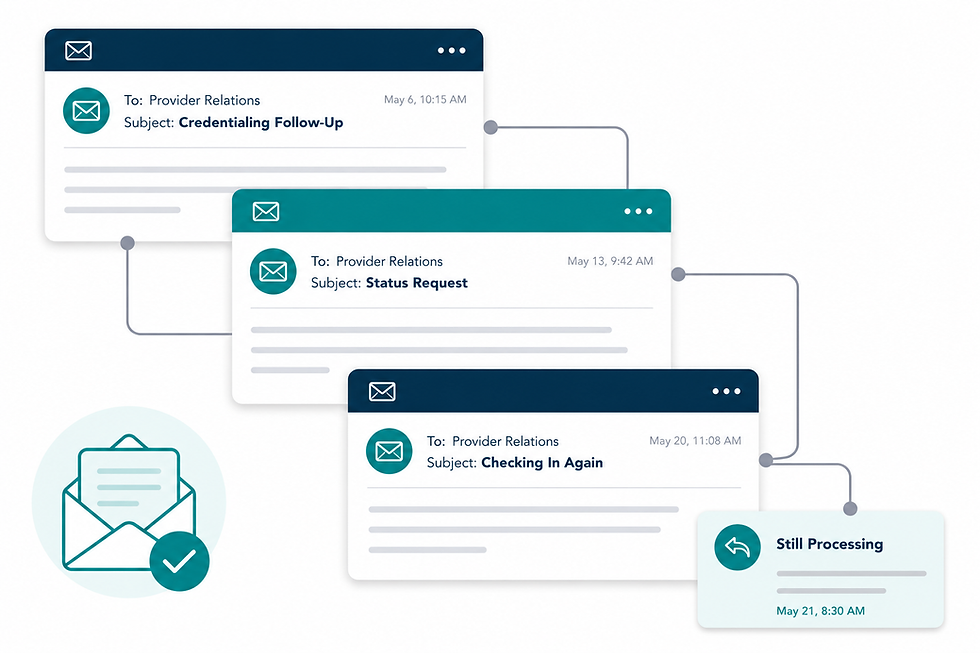
Regular follow-up allows you to confirm that the application is still moving through the process and catch problems before they sit unresolved for an extended period.
When checking a provider enrollment status, try to get more information than simply:
"It's still processing."
Ask where it is in the process. Has the application been received?
Has it been assigned for review? Are there any outstanding deficiencies? Is CAQH accessible and current? Is additional documentation needed? Has credentialing been completed?
Is contracting still pending? Does an affiliation or provider addition still need to be completed?
And whenever possible, document the representative's name, reference number, date of the conversation, and what you were told. That way, the next follow-up starts with actual information instead of starting over.
Step Five: Don't Confuse Credentialing With Contracting or Affiliation
This is an important distinction because an application can appear to be "done" while another step is still outstanding. Credentialing verifies the provider's professional qualifications.
Contracting establishes participation terms with the payer.
Affiliation or linking connects the provider to the correct group, TIN, NPI, location, or billing structure.
Depending on the payer and situation, these steps may happen together or separately.
That means hearing "the provider has been credentialed" should not automatically be interpreted as "the provider is ready to bill under our group."
Before closing an application on your tracker, make sure you understand what has actually been completed and whether any additional enrollment, contracting, or affiliation steps remain.
Read more on why Credentialing can take up to 90+ days.
The Four Dates You Should Always Track
There are plenty of dates involved in credentialing, but four deserve particular attention.
Submission Date
This is the date the application was actually submitted.
Keep proof of it.
If there is ever a question about processing time, missing applications, or a requested effective date, having documentation of the original submission can be important.
Last Follow-Up Date
This tells you how long an application has gone without attention.
Without this field, it is very easy to think someone "just checked on that one" and then realize the last payer call was actually three weeks ago.
Your tracker should also include a next follow-up date so there is always a clear next action.
Approval Date
The approval date is when the payer completes and approves the applicable credentialing or enrollment request. It is an important milestone.
But it is not necessarily the date you should use to determine when the provider can begin billing as participating.
Effective Date
The effective date is one of the most important dates to confirm.
This is the date the provider's participation or enrollment becomes effective according to the payer. And no, the approval date and effective date are not always the same.
A provider might receive approval on one date but have a different effective date assigned by the payer. Do not assume the date based on when you submitted the application, when credentialing was approved, or when someone told you it was "complete." Get the effective date confirmed.
Approval Date vs. Effective Date: Why It Matters
This distinction can create real billing problems if it is overlooked.
Imagine your practice receives notice that a provider's application has been approved.
Everyone celebrates, the provider begins seeing patients, and billing starts submitting claims.
Then the claims deny because the payer assigned an effective date that is later than the approval date.
Now the billing team has another problem to solve. Some payers may allow retroactive effective dates or other options depending on the enrollment type and circumstances, but that should never be assumed.
Before treating a provider as participating, verify the effective date and document where that information came from.
Verify the Provider Was Loaded Correctly
You have the approval. You have the effective date.
Done? Almost.
The last thing you want is to discover that the provider was approved but something did not get loaded correctly in the payer's system.
Depending on the payer, you may want to verify the provider appears correctly in:
The payer's provider portal
Your group's roster
The payer's provider directory
The correct service location
The correct group or TIN
Written approval or affiliation documentation
Contract documentation, when applicable
If something does not match what you expected, address it before assuming the enrollment is completely finished.
A provider can be approved on paper and still encounter billing problems if the payer's system does not reflect the correct group, location, or affiliation.
Don't Close the Tracker Too Early
One of the easiest credentialing mistakes to make is changing an application status to "complete" the moment an approval email arrives.
Instead, your final checklist should answer:
Is credentialing complete?
Is contracting complete, if required?
Is the provider affiliated with the correct group?
Is the correct location loaded?
Do we have the effective date?
Do we have documentation confirming it?
Is anything else outstanding?
Only then should the application really be considered complete.
Credentialing Follow-Up Is Where the Details Matter
Submitting a clean application is important, but a good submission can still run into problems after it leaves your hands. That is why credentialing cannot be treated as a one-and-done administrative task.
Someone needs to own the process from submission through completion.
That means tracking every application, checking payer application status, resolving deficiencies, documenting conversations, confirming affiliations, and verifying effective dates before assuming a provider is ready to bill. The goal is not just to get an application submitted.
The goal is to get the provider all the way through the process.
Need Help Keeping Credentialing Applications on Track?
If your credentialing tracking system consists of old emails, portal screenshots, sticky notes, and someone saying, "I think we called them a couple of weeks ago," it might be time for a more structured process.
Upstate Healthcare Administration provides credentialing and payer enrollment support from initial application through follow-up and completion.
We help practices track submissions, monitor provider enrollment status, respond to credentialing deficiencies, follow up with payers, and confirm the details that matter before an application is closed.
Learn more about our credentialing and payer enrollment support and see how we can help keep your applications from getting lost in the shuffle.
Frequently Asked Questions
How often should I follow up on a submitted credentialing application?
There is no single follow-up schedule that works for every payer. The appropriate timing depends
on the payer, application type, and processing timeframe. The important thing is to have a consistent follow-up schedule rather than submitting an application and leaving it untouched until the estimated completion date.
What's the difference between an approval date and an effective date?
The approval date is when the payer approves the applicable credentialing or enrollment request. The effective date determines when the provider's participation or enrollment becomes effective. These dates are not necessarily the same, so practices should verify the effective date directly rather than assuming approval means the provider can immediately begin billing as participating.
How do I know if my credentialing application has a deficiency?
The payer may contact you, update the application status in its portal, or request additional information. However, notifications are not always obvious. Regular status checks can help identify missing documents, expired information, or other deficiencies before they remain unresolved for an extended period.
What should I ask when calling a payer about a credentialing application?
Ask whether the application has been received, its current status, whether anything is missing, whether there are outstanding deficiencies, and what steps remain before completion. Also ask for a reference number for the call and document the information you receive.
Is a provider ready to bill as soon as credentialing is approved?
Not necessarily. Credentialing may only be one part of the process. Contracting, group affiliation, payer enrollment, or other steps may still need to be completed. The practice should confirm the provider's effective date and correct enrollment or affiliation before assuming the provider is ready to bill as participating.

Take Control of Your Time-to-Revenue Today
Our credentialing specialists streamline provider onboarding, handle end-to-end clearinghouse enrollments, and track every payer effective date to get your clinicians billing safely and quickly.
Or if you want actual strategic guidance - not a template, but someone who can look at your specific payer mix, specialty, and practice structure and give you a real plan - you can book a strategy session through Upstate Healthcare Administration.
Comments